Uneven concrete is one of those home issues that tend to sneak up on you. One season your driveway looks fine, and the next there’s a noticeable dip near the garage. Understanding what causes it and what your repair options are can make a big difference when it comes time to take action and restore your driveway.
Why does concrete become uneven?
Concrete slabs don’t shift on their own. Something underneath them changes first, with soil movement being the most common culprit. As moisture levels rise and fall with the seasons, the ground beneath a slab expands and contracts. Over time, that repeated movement causes sections to settle unevenly.
A few other common causes include:
- Poor soil compaction during the original installation
- Soil erosion from water runoff washing away material beneath the slab
- Tree roots growing underneath and displacing the ground
- Freeze-thaw cycles that shift the soil repeatedly over winter
- Plumbing leaks that saturate and weaken the soil below
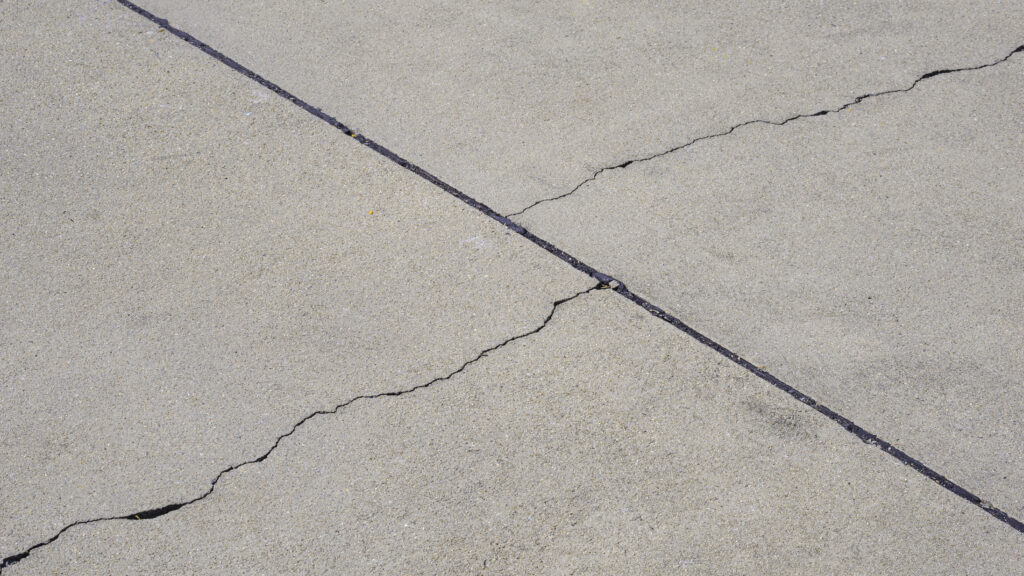
Once the ground shifts, the slab above it follows. That’s when you start to see cracks, raised edges, and those tripping hazards along your sidewalk or patio.
Where uneven concrete commonly appears
You might notice settling on your driveway, front walkway, patio, pool deck, or garage floor. Steps and stoops are also prone to sinking over the years. These are all high-traffic areas, which is exactly why getting them repaired sooner rather than later is a smart move. Proper ground preparation plays a major role in how long any concrete surface holds up.
Leveling solutions professionals use
The good news is that uneven concrete doesn’t always mean a full replacement. Several effective leveling methods are available, and a qualified professional can help determine which one fits your situation best.
Mudjacking is one of the most established techniques. A contractor drills small holes into the sunken slab and pumps a grout mixture underneath to lift it back into place. It’s been used for decades, and it works well for many residential applications.
Polyjacking (also called polyurethane foam lifting) is a newer approach that works on the same principle. Expanding foam is injected beneath the slab, filling voids and raising the concrete. It’s lightweight, it cures quickly, and it leaves minimal visible marks on the surface.
Self-leveling overlays can address minor surface irregularities indoors, though they work best when the underlying ground is already stable.
A professional assessment is the best way to identify which method makes sense for your specific slab, soil type, and the extent of the settling. You can learn more about what goes into concrete slab installation and repair to get a better sense of what’s involved.
Take the next step
If you’ve noticed uneven or sunken concrete around your home, a professional evaluation is a great place to start. Visit our Marketplace page to connect with a trusted local expert who can assess the problem and recommend the right solution for your property.
For more advice on tackling home improvement projects, follow us on Instagram for inspiration, tips, and local home improvement resources.